Guide: The 90-day rule for carrying passengers
To carry passengers, you need landings of your own from the last 90 days. This guide puts EASA FCL.060 and FAA 61.57(a) side by side, works through an example and links to the official text.
. This guide does not replace the official regulation text.
In short
EASA: as PIC or co-pilot with passengers or in commercial air transport, you need at least 3 take-offs, approaches and landings as pilot flying in the preceding 90 days, on the same type or class.
FAA: as PIC with persons on board, you need at least three take-offs and three landings as sole manipulator in the preceding 90 days, in the same category, class and, where required, type.
EASA: FCL.060(b)(1)
FCL.060(b) covers aeroplanes, helicopters, powered-lift aircraft and airships. Under (b)(1), you may only fly as PIC or co-pilot in commercial air transport or with passengers after at least 3 take-offs, approaches and landings as pilot flying in the preceding 90 days, in an aircraft of the same type or class or an FFS representing it.
Depending on your privileges, these count in multi-pilot or single-pilot operations. To fly as PIC at night, (b)(2) also requires at least 1 take-off, approach and landing at night as pilot flying in the preceding 90 days, unless you hold an IR.
FAA: 14 CFR 61.57(a)
Under 61.57(a)(1), you may only act as PIC of an aircraft carrying persons, or of one that requires more than one pilot, after at least three take-offs and three landings in the preceding 90 days: as sole manipulator of the controls, in the same category and class and, if a class or type rating is required, the same type. In a tailwheel aeroplane, only full-stop landings count.
To get those landings, (a)(2) lets you fly as PIC by day under VFR or IFR with nobody on board beyond those needed for the flight. Under (a)(3), landings also count in an FFS or FTD the FAA has authorised for landings, used in an FAA-authorised course at a Part 142 training centre.
The differences at a glance
Both rules ask for landings from the last 90 days but differ on role, simulators and night flying.
| Topic | EASA FCL.060(b) | FAA 61.57 |
|---|---|---|
| Applies to | PIC or co-pilot in commercial air transport or with passengers | PIC with persons on board, or where the aircraft requires more than one pilot |
| Period | Preceding 90 days | Preceding 90 days |
| Number | 3 take-offs, approaches and landings | 3 take-offs and 3 landings |
| Role | Pilot flying | Sole manipulator |
| Aircraft | Same type or class | Same category and class, plus type where a rating is required |
| Simulator | FFS representing the type or class | FFS or FTD authorised for landings, in a Part 142 course |
| Tailwheel | No separate requirement | Full-stop landings in a tailwheel aeroplane |
| Night | As PIC: 1 take-off, approach and landing at night, or an IR | With persons on board: 3 take-offs and 3 full-stop landings at night |
An example
Pia (fictional) flies a single-engine piston aeroplane and lands once each on 3, 10 and 17 March. Her third-most-recent landing is on 3 March. Add 90 days, that is 28 to the end of March, 30 in April, 31 in May and 1 in June, and you get 1 June.
That is how far her status runs in Log-K. If Pia lands again on 20 May, the landings on 10 March, 17 March and 20 May count, and the status runs to 8 June (10 March plus 90 days).
How Log-K shows your status
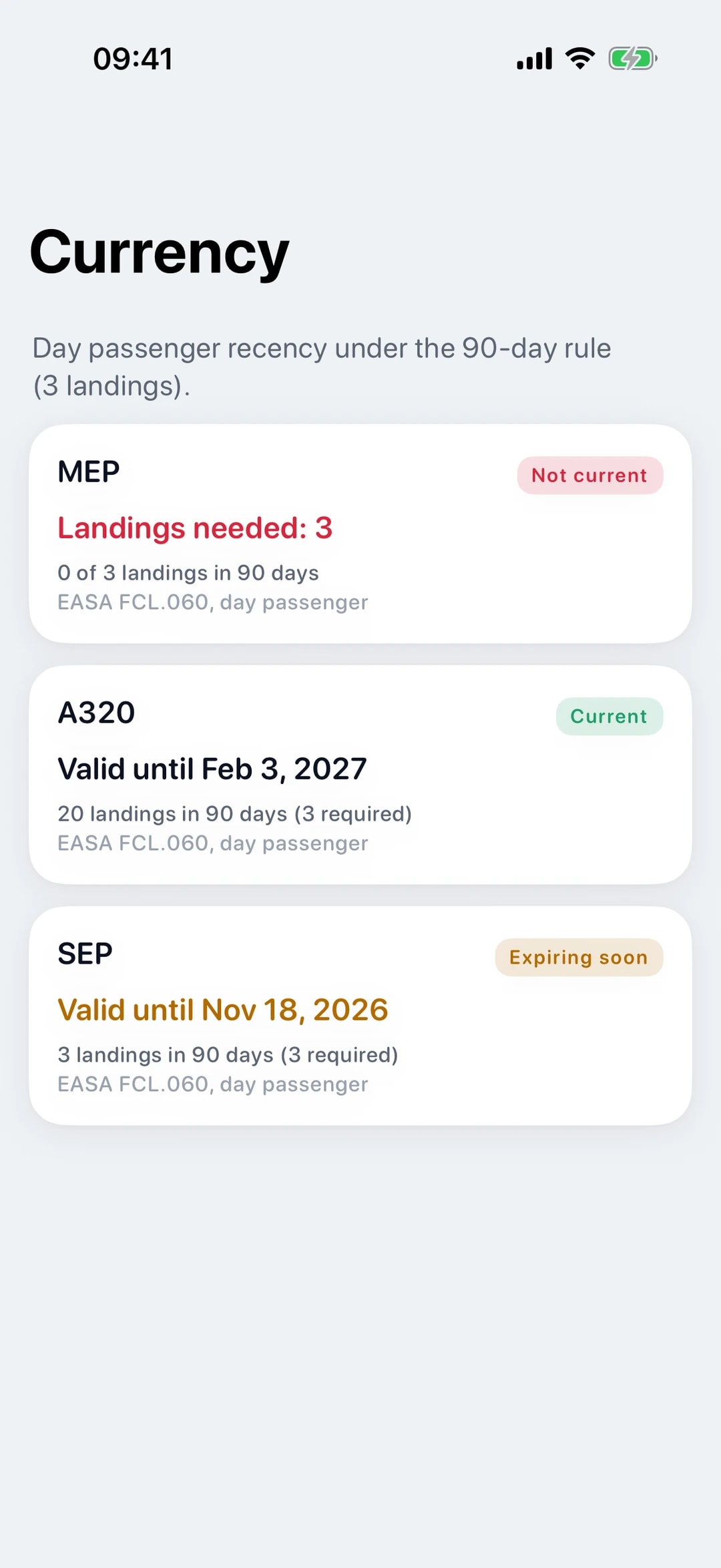
Log-K counts your landings of the last 90 days, grouped by rating or type. It does not check take-offs, whether you were pilot flying or sole manipulator, or full-stop landings. Log-K does not count simulator landings, even though FCL.060 and 61.57 allow them under certain conditions.
You see the status in the iOS app and in the web logbook (currently in German) under Currency, with the date it lasts until without new landings. The other requirements are yours to check.
Sources
EASA: Easy Access Rules for Aircrew (Part-FCL), FCL.060. FAA: 14 CFR 61.57 in the eCFR.
Special cases such as the extension for commercial air transport under FCL.060(c) are not covered.
Frequently asked questions
Does the 90-day rule apply when nobody else is on board?
Can I make up the landings in a simulator?
Is there a separate rule for night flights?
Related pages
Your logbook, digital from today.
Free in the open beta. For iPhone and iPad, plus the web logbook (currently in German).